


Mental Health In Athletes: Why It Matters And How To Get Support
In 2021, Simone Biles withdrew from several Olympic gymnastics finals in Tokyo. Her reason was simple: her mental health had to come first, and competing wasn't safe until it did.
The reaction was global, but the underlying truth wasn't new. Athletes have carried this weight for as long as sport has existed; what changed is that one of them said so, in public, on the biggest stage there is.
Mental health in athletes deserves more than a headline moment. Here's why it matters, what actually separates mental health from mental performance, and how to get real support in Malaysia. That last part is the one most guides skip.
Why Mental Health In Athletes Matters
Mental health symptoms and disorders are common among elite athletes. That's the finding of the International Olympic Committee's own consensus statement on the subject, and it's the single most citable fact in this field.
19% to 34% of current elite athletes report mental health symptoms, a range that spans everything from alcohol misuse (19%) to anxiety and depression (34%) at the high end. Former elite athletes carry a lower but still real rate of 16% to 26%, from distress to anxiety and depression.
The same consensus statement makes a sharper point: mental health symptoms can present differently in athletes than in the general population, often masked by performance or waved off as "just pressure".
Mental and physical health aren't separate ledgers, either. Injury raises mental health risk, and poor mental health raises injury risk right back; the two move together.
None of this means athletes are worse off than everyone else on every measure. Elite athletes carry a broadly comparable risk of anxiety and depression to the general population, though the evidence on eating disorders, substance use and stress is thinner and less consistent.
What that comparable risk hides is how much of it goes unaddressed. An athlete's relationship with struggle is shaped by sport culture long before it's shaped by anything else, and that culture decides whether anyone ever says anything at all.
None of these conditions are a character flaw. They're common and treatable, and the barrier is usually what happens next, not the condition itself.
That's where an athlete's well-being starts to depend on the culture around them, not willpower alone.
The Malaysian And Asian Context
Malaysian sport carries a familiar script: struggle reads as a discipline failure, not a health issue, and a "tough" athlete doesn't talk about it. That script has a name in the research literature, and it's the single biggest reason athletes don't seek help.
Among young elite athletes, stigma is the most commonly reported barrier to help-seeking: fear of being seen as weak, fear of a coach's reaction, and fear of being seen as unable to cope. Social support, positive coach attitudes and a good first experience with a provider all make athletes more likely to reach out.
That pattern isn't only international. Malaysian elite athletes name the same barrier themselves: stigma around mental health, alongside a limited personal understanding of what mental health even covers.
Malaysia- and Asia-specific research on athlete mental health is still thin. That's a genuine gap in the evidence, not a reason to treat the topic as unimportant.
That gap matters practically, not just academically. Stigma is the wall between an athlete who's struggling and the help that already exists, and the rest of this article is a map through it.
Common Conditions In Athletes, Described Responsibly
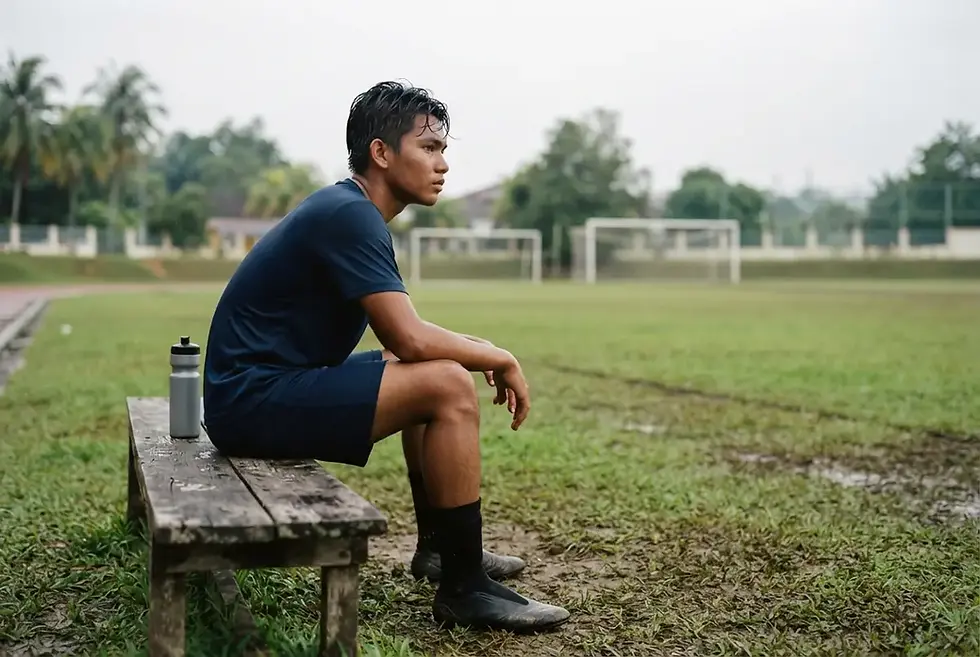
This section is an orientation, so the terms in this article mean something concrete. It is not a checklist for diagnosing yourself or anyone else.
Anxiety shows up as persistent worry, racing thoughts before or during competition, or physical tension that doesn't ease once the whistle blows. It's different from the nerves every athlete feels before a big match: the difference is duration, intensity and how much it interferes with daily life, and that call belongs to a professional, not a self-test.
In our coaching work, the sign we notice first is usually behavioural rather than physical: an athlete who rushes through their warm-up, or withdraws into silence to avoid interaction before a match, is often trying to hide from the anxiety rather than manage it. A lost appetite, poor sleep the night before, obsessing over small execution details and unusual irritability during warm-ups belong on the same watch list.
Depression looks like a flat, heavy mood that doesn't lift, loss of interest in a sport an athlete used to love, and exhaustion that rest doesn't fix. Athletes often describe it as "just going through the motions" long before they'd use the word depression.
Disordered eating involves a preoccupation with food, weight or body image that starts to control training, mood or self-worth. It's common in sports with a weight class, aesthetic scoring or a lean-body ideal, and it's frequently missed because it can look like discipline from the outside.
Burnout overlaps heavily with depression: exhaustion, cynicism about a sport once loved, and a drop in performance despite training harder. What separates it is the cause: burnout builds from chronic overload across a season rather than arriving as a mood disorder.
Injury belongs on this list too: it's a well-documented mental health risk factor, not just a physical setback.
Recovery runs on two tracks, and the psychological track of rehab deserves as much attention as the physical plan; it can even speed the return. Every condition on this list is common and treatable, and none of them make an athlete weak, broken or finished.
Mental Skills Vs Mental Health: The Crucial Line
Here's the line this whole article is built around. Mental performance coaching is unregulated in Malaysia: no licence, no register, no protected title, and anyone can call themselves a coach.
Clinical mental health concerns are different. They need a clinical, regulated professional, either a registered clinical psychologist or a registered counsellor, both legally accountable in a way coaching simply isn't.
Mental skills / performance coaching | Mental health / clinical care | |
|---|---|---|
What it addresses | Focus, confidence, motivation, routines, handling pressure | Diagnosable conditions: depression, anxiety disorders, eating disorders, substance use |
Who provides it | A mental performance coach (unregulated in Malaysia) | A registered clinical psychologist or registered counsellor (regulated, licensed) |
What it looks like | Skills training, goal setting, mental rehearsal, ongoing coaching sessions | Assessment, diagnosis, therapy and, where appropriate, medication |
When it fits | Performance is the concern and nothing clinical is present | Symptoms are persistent, affecting daily life, or involve thoughts of self-harm |
A good coach treats that right-hand column as someone else's job, not a challenge to solve. Awareness of the line isn't enough on its own; sport needs a real early-intervention pathway connecting the athlete, coaches, parents and the wider sporting system, not just a poster that says "talk to someone".
From our practice, that boundary shapes every engagement. Coaching sits on the performance side of the spectrum, and its job is to help a healthy athlete clear the mental barriers between them and their full potential. The moment a session surfaces something clinical, the responsible move is a referral to a registered clinical professional, because that is where the athlete gets the specialised care performance work was never designed to provide.
That's the difference between sport performance anxiety (nerves a coach can tame) and an anxiety disorder, a clinical condition that needs a clinician. Confusing the two is exactly how athletes end up "coached through" something that needed a referral instead.
That line runs through sport psychology as a whole field: the clinical versus performance split decides everything from training routes to who is legally accountable for what.
On the coaching side, what a coach actually does day to day (skills training, routines, structured review) is narrower and more practical than the marketing suggests.
Internationally, bodies like AASP in the United States and the ISSP set voluntary certification standards for the profession. Malaysia has no equivalent register, so a coach's credentials and scope should be checked directly with the coach, not assumed.
How To Get Support In Malaysia

This is the part most articles about athlete mental health skip, so here's a working map instead of a vague "seek help" line.
Who | What they help with | Regulation |
|---|---|---|
Mental performance coach | Performance-side support: focus, confidence, motivation, routines | Unregulated in Malaysia; no licence or official register |
Registered counsellor (kaunselor berdaftar) | Talk therapy, life stress, adjustment issues, mild-to-moderate concerns | Counsellors Act 1998; registered with Lembaga Kaunselor Malaysia |
Registered clinical psychologist | Diagnosable conditions, formal assessment, treatment planning | Allied Health Professions Act 2016; registered with MAHPC |
GP | A common real-world first stop; can assess and refer into the public or private system | Registered medical practitioner |
Crisis support | Immediate distress, suicidal thoughts, danger to life | Talian HEAL 15555, Befrienders KL, Talian Kasih 15999, 999 |
Two of the rows above are legally protected titles, not marketing labels. A registered counsellor must be registered with Lembaga Kaunselor Malaysia under the Counsellors Act 1998 and hold a practising certificate.
A registered clinical psychologist must be registered with the Malaysian Allied Health Professions Council (MAHPC) under the Allied Health Professions Act 2016 and hold a practising certificate.
A GP is often the simplest place to start. Most GPs in Malaysia can carry out an initial assessment and refer an athlete into the public or private mental health system from there.
If you or someone you know is in crisis, help is available right now. Talian HEAL 15555, the Ministry of Health's dedicated mental health crisis line, is staffed by psychology officers and counsellors from 8am to midnight daily.
Befrienders KL (03-7627 2929) offers 24-hour emotional support in Bahasa Malaysia, English, Chinese and Tamil for anyone feeling distressed, hopeless or having thoughts of suicide.
Talian Kasih 15999, run by the Ministry of Women, Family and Community Development, operates 24 hours and mainly handles abuse and family welfare cases, though it also takes general distress calls. For immediate danger to life, call 999.
Malaysia also has dedicated sport-specific infrastructure worth knowing about. The National Sports Institute's Sports Psychology Centre supports athletes inside national programmes, though its scope is elite and national-level, not a public walk-in clinic.
Where does Mind Gap fit into this map? On the performance side, always alongside the clinical pathway above, never instead of it.
If what you need is performance-level support, that's mental performance coaching for athletes. If what you need is clinical care, the table above is where to start, and it takes priority every time.
How To Support A Teammate Or Child
You don't need to be a professional to help someone take the first step. You need to listen without trying to diagnose them.
Skip the reflexive reassurances. "Just relax" and "everyone gets nervous" shut a conversation down fast, even when they're meant kindly.
In our coaching work, we remind parents and coaches that nobody can be reasoned out of an emotional state, least of all panic. What helps instead is modelling calm curiosity: grounding questions such as "What's your plan for the first five minutes?" or "Which of your strengths do you want to show in this match?" The adult stays a steady anchor while the athlete learns to navigate their own energy.
Encourage professional support rather than trying to fix the problem yourself. Positive attitudes from teammates and coaches are among the strongest predictors of whether a struggling athlete actually reaches out.
Know the numbers from the table above before you need them. Having Talian HEAL 15555 or Befrienders KL saved in your phone costs nothing and can matter enormously in the moment it's needed.
Parents carry a particular version of this. Checking in regularly, without turning it into an interrogation, keeps the door open long before a crisis forces it.
Mindfulness is one practical tool here: it trains young athletes to notice and name their feelings, which makes these conversations easier on both sides.
For sport-specific anxiety in a child or teenager, the day-to-day work (what to say before matches and how your own sideline habits land) is its own parenting skill.
The Coach's Role

A responsible coach builds the performance side: focus, confidence, motivation, and the routines that hold up under pressure. That's the whole job description, and it stops exactly where a clinical concern begins.
Watching for signs that something's beyond that scope is a baseline part of doing the job responsibly.
A coach who notices persistent low mood, withdrawal, disordered eating patterns or anything resembling the conditions covered earlier should refer out early, not wait to see if it passes. That referral is a sign the system is working, not a failure of coaching.
Coaching supports the performance game. Clinical professionals treat the health condition, and neither substitutes for the other.
If you're looking for that kind of scoped, honest support, mental performance coaching for athletes is what we do. Referring out when it's not our lane is part of how we do it.
Frequently Asked Questions
Why Is Mental Health Important In Sports?
Mental health symptoms and disorders are common among elite athletes, and they're inseparable from physical health and performance (Reardon et al., 2019). Ignoring them only delays the support an athlete eventually needs.
What Mental Health Issues Do Athletes Commonly Face?
Anxiety and depression, at rates comparable to or higher than the general population: mental health symptoms range from 19% to 34% across current elite athletes in one meta-analysis, with anxiety/depression at the highest end of that range (Gouttebarge et al., 2019). Burnout, disordered eating and the psychological effects of injury are common too.
What's The Difference Between A Mental Performance Coach And A Psychologist In Malaysia?
A coach, unregulated in Malaysia, works on performance skills like focus and confidence. A registered clinical psychologist (MAHPC) or registered counsellor (Lembaga Kaunselor Malaysia) is legally regulated to assess and treat mental health conditions.
Where Can Athletes Get Mental Health Help In Malaysia?
Registered counsellors and clinical psychologists for ongoing care, a GP as a practical first stop, and Talian HEAL 15555 or Befrienders KL (03-7627 2929) for crisis support. Call 999 if there's immediate danger to life.
Why Don't Athletes Seek Help For Mental Health?
Stigma: the fear of being seen as weak or unable to cope is the most consistently reported barrier, in international research (Gulliver et al., 2012) and in Malaysian athletes specifically (Foong & Kwan, 2021). Positive coach and teammate attitudes are one of the strongest counters to it.
Can A Mental Performance Coach Treat Depression Or Anxiety Disorders?
No. Coaching supports performance and can help an athlete stay engaged with treatment, but diagnosis and treatment are the legal responsibility of a registered clinical psychologist or counsellor.


Comments