


Top 5 Mental Attributes Every Goalkeeper Needs

Updated: Jul 20
"I honestly think goalkeepers are people who are a little crazy. Our role is special, atypical, and we have a different make-up."
Legendary Italian goalkeeper Gianluigi Buffon has won 29 major titles across his playing career that spanned three decades. It's no wonder he said that about his own position, and the way goalkeepers behave under pressure backs him up.
Facing a penalty, professional goalkeepers dive to one side on roughly 94 percent of attempts, even though standing still in the centre gives a statistically better chance of a save. Researchers call this action bias: the pull to look like you are doing something, even when doing nothing is the smarter play.
That single finding says more about goalkeeping than any highlight reel. The position demands split-second physical reactions, but those reactions sit on top of a mental layer most training sessions never touch directly: the layer that decides whether a keeper trusts their positioning enough to stay still, or resets fast enough after a mistake to make the next save. Below are five mental attributes that separate a reliable goalkeeper from a shaky one, what each one does under the surface, and a concrete way to train it.
1. Focus And Concentration

Every goalkeeper has seen the clip: a keeper ball-watching, adjusting a glove, shouting instructions, then turning back just late enough to see the ball already in the net. Concentration lapses like this follow a pattern. Attention narrows or widens depending on how "busy" a match feels, and a quiet game is often more dangerous than a hectic one, because nothing is forcing the mind to stay switched on.
The mechanism sits in where the eyes settle before the moment of truth. Research on penalty saves has found that better-performing goalkeepers fix their gaze on a stable point, usually the ball or the taker's hip, in the final moment before the shot, rather than letting their eyes drift across the run-up. The habit has a name in sport science: a "quiet eye" period, and it is trainable rather than innate.
A concrete way to train it: build a reset routine that fires on every stoppage, not only before penalties. Touch both posts, exhale once, then run a fixed scanning pattern, ball, space, nearest attacker, before the game restarts. Rehearsed until automatic, the same three-second routine becomes the trigger that pulls attention back to alert readiness during a real match, whether the last action was 30 seconds or 30 minutes ago. The routine is goalkeeping-specific; the attentional control underneath it is not, and outfield players train it the same way.
2. Acceptance
Two things sit under this attribute, and mixing them up is where a lot of goalkeepers get stuck.
The first is accepting that mistakes are part of the role, not proof of failure. A goalkeeper's errors get magnified by where they happen: a misjudged clearance from a striker is forgotten by half-time, a misjudged claim by a goalkeeper usually ends up in the net. Chasing "perfect" turns every match into a test the keeper is already failing, and that pressure shows up as hesitation at exactly the moment decisiveness matters most.
The second is accepting the isolation built into the position. Goalkeepers train separately for large parts of a session, follow a different warm-up, and carry responsibilities no outfield player shares, while still needing to be a full member of the dressing room. As former Australian international goalkeeper Ante Covic has observed, goalkeepers carry mistakes in a way outfield players don't — one misjudgement is remembered long after a midfielder's stray pass is forgotten.
In our coaching work, one pattern shows up across almost every sport: athletes chase control over as many situations as possible, believing that more control means less anxiety on match day. There is no such thing as full control. A referee's call, a moment of bad luck or a flash of genius from an opponent can all go against a goalkeeper playing their best match. The confidence worth building comes from knowing the controllables, your breathing, your game plan and the mindset you carry onto the pitch, and embracing the fact that the rest can happen even on your best day.
Coaches can train this directly: a short, scripted error debrief, used straight after a mistake in training rather than days later in review. State what happened in one neutral sentence, name the one adjustment for the next ten minutes, then move on. Coaches who run this drill deliberately, making a keeper say the mistake out loud and set the next action, build the habit faster than any post-match team talk does. It also builds the self-belief that steadies a keeper through a rough afternoon.
3. Resilience

Mental resilience, the capacity to recover from a setback and perform again soon after, matters more for goalkeepers than almost any other position, because the setbacks are so visible. A misplaced pass in midfield draws far less scrutiny than a spilled shot that ends up as a tap-in, and the goalkeeper who cannot let go of the last action is the one who concedes the next one too.
Sport psychologists studying resilience in high-level performers describe a specific mental shift behind it: appraising a setback as a challenge to solve rather than a threat to survive. That shift changes what the nervous system does in the following seconds: whether it stays in problem-solving mode, or tips into self-protection.
From our practice, the spiral after a conceded goal has a name: future tripping. The mind jumps ahead to the rest of the match, worrying about making the same mistake again, and the worry compounds into catastrophising. The keeper's only job in that moment is to bring the brain back to the next play, and a prepared cue gets there faster than willpower: a short verbal trigger rehearsed in training, something as plain as "clear the ball" or "back to base", snaps the panic spiral before it settles in. Anxiety also thrives in isolation, so a quick word with a centre-back or even a high five re-engages the social regulation part of the brain.
One way to build it: "next job" repetition drills in small-sided sessions, where the goalkeeper faces a rapid sequence of shots with almost no recovery time between them, some saved, some not. Save percentage during the drill barely matters. What it rehearses is the turnaround between one action ending and the next one demanding full attention, so that conceding in the 60th minute of a real match doesn't cost a save in the 61st.
4. Composure
Keep calm and goalkeep. Composure is what allows the other four attributes to show up under match conditions instead of collapsing the moment the pressure spikes.
A rattled goalkeeper's decisions get faster and worse at the same time: a rushed punch instead of a controlled catch, an early dive instead of a set position. The mechanism sits in the body before it shows up in a decision. Heart rate and breathing quicken automatically under threat, and that physical state narrows attention and pushes a person toward the fastest available option rather than the best one. Composed goalkeepers are not simply calmer by personality; they have trained a way to interrupt that spiral before it takes over.
In our coaching work, "calm down" is an instruction we deliberately avoid. Forcing relaxation onto a body that is fully hyped up works about as well as asking a train at full momentum to stop on the spot. What we coach is regulation: a quick reset built on box breathing, four seconds to breathe in, four to hold, four to breathe out, four to hold, repeated two or three times. The pattern steadies the oxygen reaching the brain, and it sends the keeper a second signal that matters just as much: you are back in control, ready to execute the next action.
Train it with a fixed pre-action routine: attach it to goal kicks, back passes, and penalties alike, ball placement, one slow exhale, a single cue word, then the action. Rehearsed until it is automatic in low-stakes training, the same routine holds up when a packed Bukit Jalil crowd goes quiet to watch a single decision during a Harimau Malaya fixture. Composure also sets how a keeper rides a match's emotional swings, from frustration after a bad call to relief after a big save.
5. Anticipation
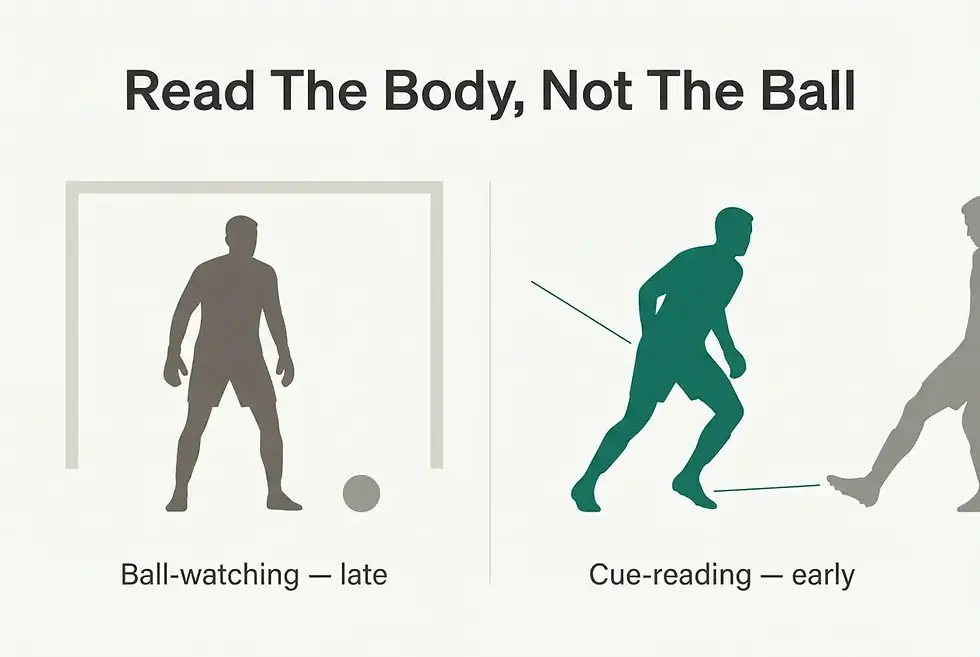
Reading the game before it happens is what turns a shot-stopper into a goalkeeper opponents struggle to beat one-on-one. Modern attacking transitions move fast enough that reacting to the ball alone leaves a keeper permanently a half-step behind; anticipation is what closes that gap.
The mechanism is pattern recognition. Research into penalty-facing goalkeepers has found that better performers pick up cues from a taker's hip angle and plant-foot position during the run-up, well before the ball is struck, rather than watching the ball itself. The same principle applies in open play: reading a striker's body shape before a cross, or a midfielder's hips before a through ball.
The drill that builds it: occlusion training, where video of a striker's run-up or a winger's delivery is cut a fraction of a second before contact, and the goalkeeper calls the outcome before seeing it. Run regularly, this drill sharpens the specific skill of reading early cues rather than reacting late, the same skill that separates a keeper who saves a one-on-one from one who is left stranded. Goalkeepers in the Malaysia Super League face this test constantly against sides built to counter-attack at pace, where a slow read on a transitional break is often the difference between a save and a goal conceded in transition.
These Attributes Are Trainable
None of the five attributes above are traits some goalkeepers are born with and others are not. Focus, acceptance, resilience, composure, and anticipation are skills, and skills respond to structured practice the same way handling technique or distribution does. The goalkeepers who look mentally bulletproof on matchday are usually the ones who rehearsed the reset, the routine, and the read hundreds of times when nobody was watching.
FAQ: Mental Attributes Of A Goalkeeper
What Is The Most Important Mental Attribute For A Goalkeeper?
Composure is usually the foundation. It decides whether focus, acceptance, resilience, and anticipation can show up in a pressured moment instead of being overridden by a rushed decision.
Can A Goalkeeper's Composure Be Trained, Or Is It Just Personality?
It is trainable. Pre-action routines, breathing control, and repeated exposure to high-pressure drills in training build composure the same way repetition builds handling technique.
How Should A Goalkeeper Mentally Recover After Conceding A Bad Goal?
A short, scripted error debrief works better than dwelling on it. State what happened in one neutral sentence, name one adjustment for the next passage of play, and move on before the next action arrives.
Do Outfield Players Need These Same Mental Attributes?
Yes, though the stakes and visibility differ. A defender's error is often covered by a teammate; a goalkeeper's error usually ends up in the net, which is why these attributes get discussed specifically for the position.
What Mental Skills Training Is Available For Young Goalkeepers In Malaysia?
Structured mental performance coaching for goalkeepers is still uncommon outside professional academies, but the same principles, focus routines, error debriefs, and pressure exposure in training, apply from grassroots level upward.
How Long Does It Take To Build A Stronger Goalkeeping Mindset?
It depends on repetition rather than a fixed timeline. Weekly, deliberate practice of a specific routine, such as a post-error reset, tends to show up in matches within a season rather than overnight.
Goalkeeping is one of the few positions where a single mental lapse is visible to everyone in the stadium. Mind Gap works with goalkeepers, outfield players, and their coaches across Malaysia to build these attributes through structured mental performance coaching, not a one-off pep talk. If a goalkeeper on your team is technically ready but comes undone under pressure, have a conversation with us about building the mental side of the position.


Comments